
Guidelines for Requesting an Embargo on Printed Theses and Dissertations
Applications for an embargo on printed theses/dissertations must be submitted before the degree examination, and the application must be reviewed and confirmed by the degree examination committee during the defense to determine whether the thesis involves confidential information, patent-related matters, or legal restrictions on disclosure.
(This procedure is implemented in accordance with the Ministry of Education Letter No. 1142201506. The University's Regulations have been revised accordingly.)
| Principle of Thesis Disclosure | Application Procedure | Certification Documents | Embargo Period | Additional Notes |
1.Principle of Thesis Disclosure
According to Article 16 of the Degree Conferral Act, theses and dissertations should, in principle, be publicly accessible in order to facilitate the circulation and sharing of academic research.
Immediate public access after submission helps increase the visibility and impact of research results and reduces the risk of others publishing similar findings first or engaging in improper plagiarism.
However, in certain circumstances, immediate public disclosure may present potential risks. For example:
• The thesis contains research results related to patent applications that have not yet been completed
• The thesis involves confidential information from industry–academia collaborations
• The thesis contains legally restricted or sensitive information
• In some disciplines or publishing practices, prior public disclosure of a thesis may affect subsequent journal publication
Therefore, before deciding whether to request an embargo, students are strongly advised to discuss the matter with their advisor and carefully evaluate the decision based on the characteristics of their research field and their academic or professional development plans.
|
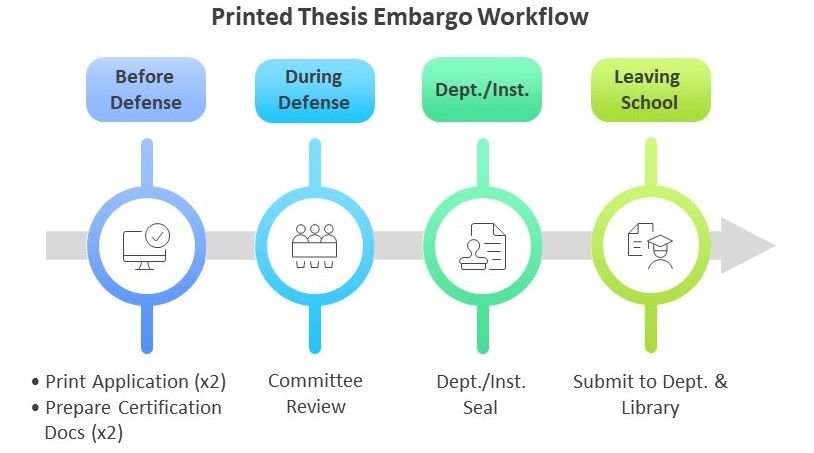
Step 1. Before the Degree Examination • Log in to the Printed Thesis Embargo Application System Step 2. During the Degree Examination Submit the application form and certification documents for review and signature by all members of the degree examination committee. Step 3. Department Confirmation Step 4. School-Leaving Process Submit the following materials: • The approved application form These documents must be submitted separately to: • The department office ※ Embargo of Electronic Theses Certification documents must provide specific factual evidence sufficient to justify the necessity of the embargo. If certification documents are not yet available, applicants must provide a written explanation describing the reasons and necessity for the embargo. Common Examples of Certification Documents (For reference only. Acceptance remains subject to review by the examination committee or departmental regulations.) Confidential Information • Industry–academia collaboration nondisclosure agreements Patent Matters • Patent application number Legal Restrictions on Disclosure If disclosure is restricted by law, the applicant must provide the applicable legal provisions or specific supporting evidence. ※ If the relevant matter is still in progress and no certification documents are currently available, applicants should explain the specific circumstances and clarify how immediate disclosure of the thesis may adversely affect relevant rights or research development. For example: •The research results presented in this thesis may have potential patent value, and the patent application process is still under evaluation or preparation. Early disclosure may affect future patent rights. • Each embargo application may be granted for up to five years. For a second or subsequent application, approval must again be obtained from: • All original members of the degree examination committee • Patent Applications Students applying for patents should make and retain a copy of the approved application form and submit it, together with the Patent Disclosure Form, to the Technology Transfer Center. • Changes to the Application If any information on the application form changes, the form must be reprinted. • Scope of This Application Printed theses held by the NTUST Library
• Electronic Thesis Access Settings Students are advised to discuss the electronic thesis access period with their advisors:
Campus network: 0–10 years |
NTUST Library Acquisition & Cataloging Division
Mon-Fri 08:30-12:00、13:20-17:00
TEL:02-27376188